You wire up an MCP server. Maybe it’s Stripe, maybe it’s your Postgres database, maybe it’s a filesystem server you found on GitHub last week. Your agent discovers the tools, reads their schemas, and now it can call them. You test it, it works, it feels a little bit like magic.
Then a quieter question shows up, usually around the time you’re about to point it at something that isn’t a toy: what actually sits between the model deciding to call delete_database and the database being deleted?
For most MCP setups today, the honest answer is: nothing. And I think that gap is worth talking about, because it’s not a bug in anyone’s code. It’s the AI agent governance layer, and the MCP ecosystem hasn’t filled it yet.
MCP solved connection, not control
MCP is genuinely good at what it does. It standardises how an agent finds tools, reads their inputs, and invokes them. The transport story is solid too - OAuth 2.1, scoped tokens, TLS. If you’ve set it up properly, you’ve controlled whether your agent can reach a server.
But that’s an access question, not an action question. Auth decides if the agent gets through the door. It says nothing about what the agent is allowed to do once it’s inside the room. And “inside the room” is where all the interesting damage lives.
Consider a support agent with two MCP tools: stripe.create_refund and postgres.query. Both are legitimately useful. Both are also, in the wrong hands or the wrong hallucination, a very bad afternoon:
- The agent misreads a ticket and issues a £50,000 refund instead of £50.
- A cleverly worded customer message convinces it to run
DELETE FROM ordersto “clean up the duplicate.” - It loops on a retry and fires the same payout forty times.
None of these require a malicious user. They’re the normal failure modes of pointing a probabilistic system at irreversible actions. The model doesn’t need to be jailbroken to do something catastrophic. It just needs to be wrong once, in the wrong place.
”I put it in the system prompt” is not a control
The instinct is to handle this with prompting. You must never issue a refund over £500. Always confirm destructive operations. And that helps, in the way a sign helps. It’s a request, not a constraint.
A system prompt is an input to the same probabilistic process you’re trying to constrain. It can be overridden by a later instruction, eroded over a long context, defeated by a prompt injection riding in on tool output, or simply ignored because the model weighted something else higher this turn. You cannot build a guardrail out of the same material as the thing you’re guarding.
Governance, if the word is going to mean anything, has to be deterministic, and it has to live somewhere the agent can’t argue with.
The control belongs in the path, not in the agent
Here’s the framing I keep coming back to: the right place for a control is in the path between the agent and the tool, not inside the agent’s reasoning.
Think of it like a customs checkpoint. You don’t ask travellers to self-assess whether they’re carrying anything they shouldn’t and trust the answer. You put a checkpoint on the route, and everything crossing the border goes through it whether it wants to or not. The agent can decide whatever it likes; the decision only becomes an action if it survives the checkpoint.
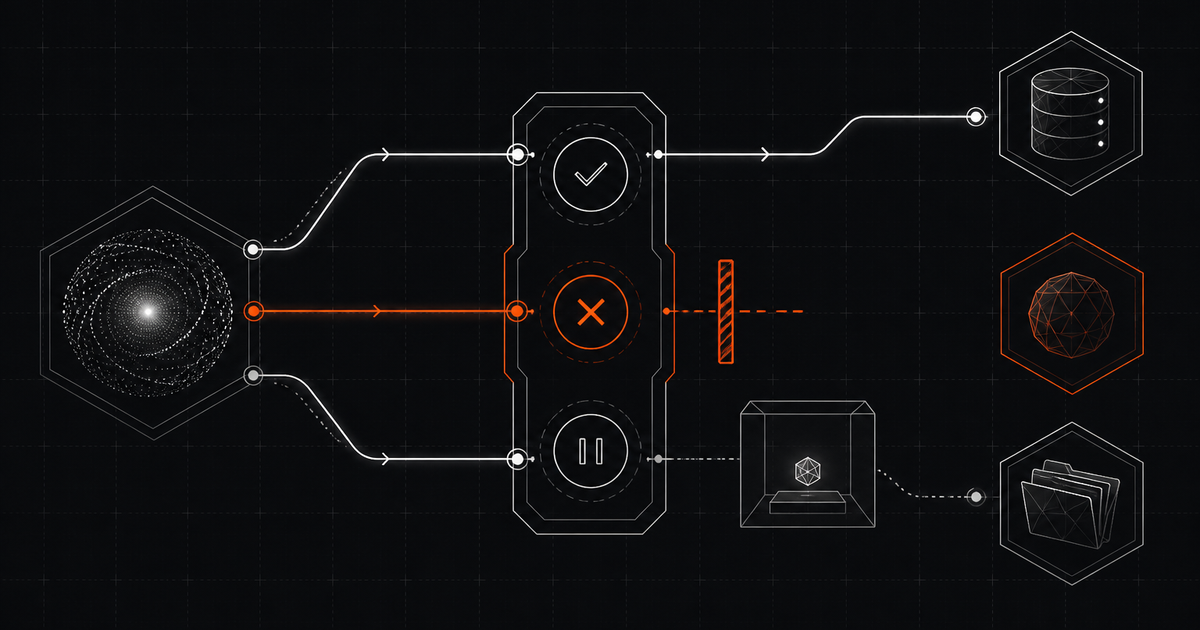
Concretely, that means a process that sits between your MCP client and your MCP servers, sees every tool call before it executes, checks it against rules you wrote, and then allows it, blocks it, or pauses it for a human. The agent doesn’t know it’s there and can’t route around it, because it is the route.
This is the thing I’ve been building - an open-source MCP governance proxy called Helio. I’ll show you what it looks like in practice, but the pattern matters more than the tool, so steal the idea even if you don’t use the project.
What a checkpoint looks like
You describe the rules in a config file. Log everything by default, block the genuinely destructive stuff outright, send the expensive or irreversible stuff to a human, and cap how much the agent can move before someone has to look at it:
# helio.yaml
default: allow # cautious teams flip this to deny and allowlist

rules:
  # Destructive SQL is a migration, not an agent decision. Block it.
  - match:
      tool: "postgres.query"
      args:
        query: "(?i)\\b(drop|truncate|delete)\\b"
    action: deny
    reason: "Destructive SQL must go through a reviewed migration"

  # Refunds over £500 pause for a human before they execute.
  - match:
      tool: "stripe.create_refund"
      args:
        amount: ">50000" # pence
    action: require_approval
    channel: slack

  # The agent can't move more than £1,000 in a single session, full stop.
  - match:
      tool: "stripe.*"
    spend_limit:
      per_session: 100000 # pence
      currency: gbp
Now when the agent decides to issue that £50,000 refund, the call doesn’t reach Stripe. It stops at the checkpoint, a request lands in Slack with the full context of what the agent was trying to do, and a human approves or denies it. The destructive DELETE never executes at all. The fortieth retry trips the session spend limit and gets refused. And every single call - allowed, denied, or approved - is written to an audit log, so when someone asks “what did the agent actually do last Tuesday,” you have an answer that isn’t a vibe.
The important part isn’t the YAML. It’s that the decision moved out of the model’s head and into a place where it’s deterministic, inspectable, and impossible to skip.
This is a layer, and most teams haven’t filled it
I’m not claiming this is the only way to do it, or that you need a dedicated tool to get started - a thin proxy you write yourself can do a surprising amount before you reach for anything heavier. What I am claiming is that the layer is real, it’s distinct from auth and transport, and right now a lot of agent deployments have a confident-looking architecture with nothing sitting in this slot. It’s the same blind spot, one level up, that let validly-signed malicious packages sail through every security check in the TanStack supply-chain attack: verifying where something came from is not the same as governing what it does.
If you’re running MCP agents against anything that costs money, changes state, or can’t be undone, it’s worth asking the checkpoint question directly: between the model’s decision and the irreversible action, what is actually checking?
If the answer is “the system prompt,” that’s the gap.
Helio is open source (Apache 2.0) and very early - the repo is here if you want to poke at it, break it, or tell me where the model’s wrong. I’d genuinely rather hear the holes now than later.

Founder of Helio. Writing about governing agents that can actually do things: policy, spend, evidence, and the incidents we keep a public record of.